

truffle dogs
What are truffle dogs?
When autumn knocks on the door and the scent of truffles graces our tables once again, we tend to forget that behind that delicious dish lies an ancient and silent ritual. The credit for every single find goes to the truffle hunters and, above all, their extraordinary dogs. Together, man and animal delve into the heart of the woods following a centuries-old tradition, passed down unchanged from generation to generation. It's not simply a search technique, but a true dance guided by understanding. A visceral bond is created between the handler and their dog, almost impossible to describe in words. It's a special relationship made of glances, blind trust, and profound empathy, where just a few gestures are enough to understand each other. And it is precisely this unique synergy that is the true key to a successful search.

What features should they have?
Let's start with a fact: Italian law requires the mandatory use of a trained dog for truffle hunting.
There are no specific breed requirements, and every truffle hunter is free to use the dog he prefers.
This does not mean that some breeds are not used more than others, are more easily trained, and are more suited to this "profession" (as always with due exceptions).
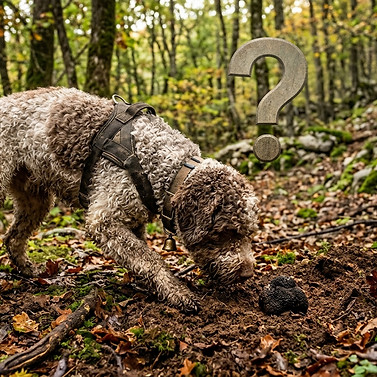
The last point is very important because while it is true that the best truffle dogs must have a highly developed sense of smell, it is also true that they must be ready to indicate the place where they need to dig, stopping instantly when their owner orders them to.
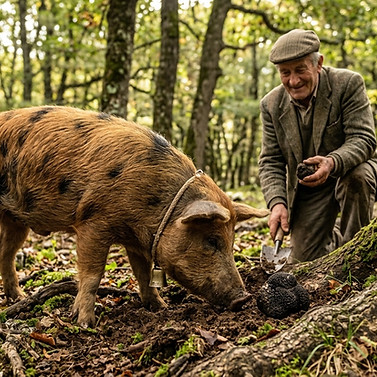
One of the reasons why in almost all countries (except France) pigs are no longer used for hunting is precisely this:
They are difficult to manage and not at all obedient, despite having perhaps the best nose for truffles.
.
But what are the truffle dog breeds?
It's difficult to establish this in absolute terms because there is no standard that regulates this aspect. In general, a good truffle dog should possess these characteristics:
- very developed sense of smell
- low attraction towards game, to avoid distractions
- physical endurance
- concentration and ability to resist distractions
- obedience and balanced character
Theoretically, any dog with these qualities could become an excellent truffle dog. However, there are breeds that have proven to have a particular inclination more than others: let's find out which are the most popular truffle dog breeds.

LAGOTTO ROMAGNOLO
In recent times it has probably been the most used truffle dog ever.
He has a very fine sense of smell even if he has lost his hunting instinct, which is why he is not distracted by game.
Affectionate, alert and not particularly demanding, it is a medium-small sized dog that is easy to train and very attached to its owner.

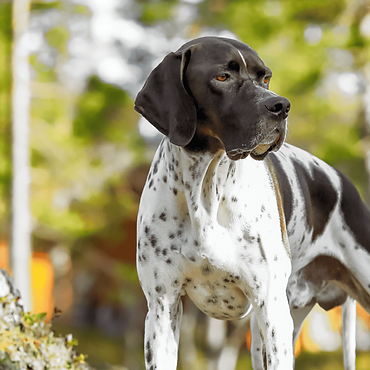
POINTER
A hunting dog with an incredible sense of smell, the pointer is a very versatile medium-sized specimen, able to adapt to all situations.
Strong and powerful, resistant and faithful, it is an excellent dog both as a companion and as a search dog.
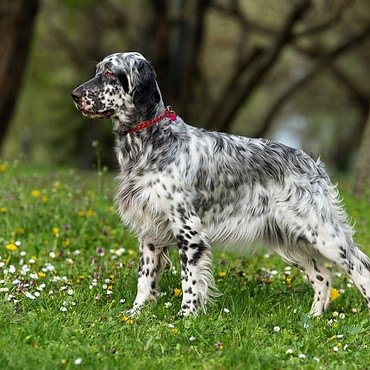
SETTER
The setter also comes in several varieties: English, Scottish, Irish, all breeds perfectly compatible with truffle hunting.
They are very energetic and active dogs, with a playful and sociable nature.
BRETON
A very intelligent and lively dog, with a great ability to adapt.
Easy to train and very obedient, he needs to move a lot, perhaps walking in the woods, and to play.

BRACCOIDS
Hungarian, Italian, German: the Pointer is one of the most prized truffle dogs, regardless of its breeds. They are hardy, versatile, and highly adaptable.

BEAGLE
A burrow hound, it is also used at airport security checks.
Dynamic, determined and usually cheerful, he has a sociable and stable character, without ever showing signs of aggression.

LABRADOR
Many people don't know this, but the Labrador is also a good truffle dog.
It is one of the most classic companion dogs, with a good character and an excellent nose.
Very agile, loves water and has a great spirit of adaptation.

COCKER SPANIEL
Full of life, cheerful and affectionate, he often has impeccable health and loves to run.
Medium-small, compact and with long ears, he is sociable and loves children.
1.jpg)
JACK RUSSELL TERRIER
A very smart, lively and confident little terrier.
Excellent as both a working dog and a companion, he is courageous and tireless.

It is also important to clarify the fact that the choice of truffle dogs must be made according to the territory in which the search is to be carried out:
In areas such as the Apennines, where there are slopes and escarpments in the woods, the most suitable dogs are Pointers, Pointers and their crossbreeds, as they are very quick in searching, have a long stride, and avoid unnecessary fatigue for their handler.
In flat areas, where the woods extend between roads and ditches, it is better to use dogs like the Lagotto, with a short stride and less frantic in their search, characteristics that make them easier to manage when called by the owner.
For the same reasons, dogs such as mongrels and Lagottos, less impetuous and more manageable, are better suited to beginners, while experienced truffle hunters will have no problem managing more “difficult” dogs such as Pointers, which are very skilled searchers, but difficult to control.

When deciding to embark on truffle hunting, one of the first big decisions involves choosing your four-legged companion. The market today offers a wide range of options, from fully trained dogs ready to roam the woods to dogs still in need of training. Regardless of the specific breed you're drawn to, there's a golden rule dictated purely by experience in the field. Those taking their first steps in this world and still a beginner should definitely choose an experienced dog. This way, the animal will become a true guide capable of compensating for the new owner's inexperience. Conversely, a professional truffle hunter has complete freedom to choose an untrained dog, as they possess the skill and experience necessary to shape the animal's character and pass on the secrets of the trade.
.
In this context, a special mention goes to the Lagotto Romagnolo, a breed that has become increasingly popular thanks to its natural predisposition for hunting and its remarkable ease of training. Selected exclusively for this purpose for almost a century, the Lagotto represents an excellent choice for both experienced truffle hunters and, even more so, for beginners.
It's important to remember, however, that breed and innate ability are only part of the equation. Almost more important than technical ability is the relationship established between dog and handler. This bond must be extremely balanced and based not on simple obedience, but on deep mutual trust. Ultimately, many factors contribute to making a dog an excellent searcher: an animal of a seemingly perfect breed, but poorly trained or poorly connected with its owner, will always perform much less well than an ordinary dog fortunate enough to work in complete harmony with its owner.

TRAINING
DISHCLOTH GAME
This game aims to introduce the aspiring truffle dog to the scent of his future “prey”.
Wrap some truffle in a tea towel, then place it in a tightly closed glass jar for three days; this will allow the tea towel to completely absorb the truffle's scent. Then, show it to your friend and play a game of tug-of-war with him. Let him win, then reward him with a "good boy" and some treats (such as kibble).
This first game can be played for a couple of days.

GAME OF BALL AND STICK
For this game, you'll need a stick with a ball tied to the end (you can make one yourself or buy it at a pet store). Place the ball on the ground and, as your dog approaches, move it slightly, making him follow it. This is a game our pets love and stimulates their attention. After a few moves, have him fetch the ball and reward him with the usual "good boy" and some treats.
As the future truffle dog becomes more and more passionate about this game, we can complicate it a few days, after which we will replace the ball with a truffle, re-proposing the game in this new way.

GAMES WITH TRUFFLE
Training your future truffle dog is now in full swing. It's essential to handle truffles with latex gloves to avoid contaminating them with your own scent (which would risk the dog searching for truffles in the truffle grounds by smelling them). We begin by throwing a truffle ball at our friend's feet and commanding him to fetch it. When the dog obeys the command, we should reward him by first removing the ball from his mouth and giving him a small treat (the usual kibble). This game, which teaches the meaning of the "fetch" command, aims to teach our friend that every time he finds a truffle, he will be rewarded.
The puppy may nibble on the truffle and try to eat it; he shouldn't be scolded. Instead, we should calmly teach him that the truffle shouldn't be nibbled; a calm "stop" will suffice. Little by little, our friend will understand what he's supposed to do.

EGG GAME
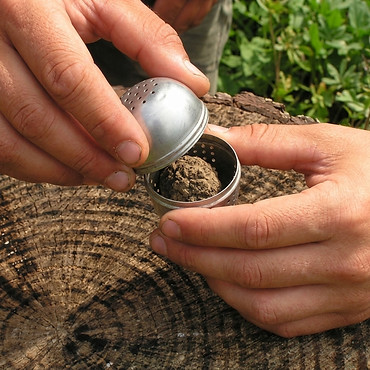
At this stage, the truffle must be placed in a perforated container, an “egg” of the kind used to prepare herbal teas.
Our future truffle dog must see when we insert the mushroom into the egg, then let him sniff it. Initially, we'll throw it near him, telling him "get it." Our friend will catch it in his mouth, but won't try to eat it since the container is metal. He might try to open it, and now is the time to teach him the "leave it" command.
We put our hand close to his mouth and tell him to release the egg; at first, our friend probably won't understand what we mean; so we'll take the container out of his mouth ourselves, always remembering to reward him.
After a while, the command will be well-received, and our friend will release the prey whenever we command him to do so. It's essential that this exercise is thoroughly mastered before moving on to the next one.
THE GAME OF THROWING AND FEtching
Using the same egg used in the previous phase, we play the game of throwing and fetching; now we throw the container slightly further away, no longer close to the paws, but at least a meter or a meter and a half away, while simultaneously commanding "fetch." Once our friend has caught the egg, we reward him with a "good boy" and order him to bring it back with a "bring" or a "come" command. Once he's close enough, it's time to say "leave it."
Once the process is complete, the usual small treat is a must, perhaps accompanied by a few pats. As our friend becomes more familiar with this game, the throws can be made further and further away; after a while, the throw should be made where there is no visual reference, so that our aspiring truffle dog uses not only sight, but also smell.
This phase must last until our friend no longer has any doubts in carrying out the various orders.

DIG INTO THE EARTH
We're almost there, our truffle dog's training has reached the final stage, the digging stage.
We bury our egg under some soil, then order our dog to search for it ("search"); after showing us where we've placed the container, our friend will start digging, and we'll encourage him. Once the egg is found, he'll take it in his mouth, and we'll order him to release it, rewarding him when our command is obeyed.
At first, the egg shouldn't be placed too deeply into the ground, but after a while, you'll increase the depth and, consequently, the time needed to find it. Encouraging your friend while he's searching is crucial; you need to teach him to persevere until he reaches his goal.
As the training days go by, we will no longer position ourselves too close to him, but a little further away while he is “working”, always giving him the command “bring” once the egg has been found and then the classic “leave it”.
As the training progresses we can modify the execution methods by adding the commands “stay” or “leave it” once our now almost ready truffle dog has reached the prey.
This serves to make it clear that we will be the ones to extract the truffle from the earth to prevent it from being crumbled.

BITS AND MUZZLES FOR TRUFFLE DOGS
One of the biggest problems facing truffle dogs is the widespread use of poisoned bait, a phenomenon that has unfortunately forced the use of tools such as bites and muzzles specifically designed for truffle dogs.
The choice between one or the other is entirely personal; there is no human judgment on these tools; some truffle hunters prefer bits, others muzzles.
